Visit the UCLA Film & Television Archive website(opens in a new tab) to learn more about upcoming screenings and events.
Free admission. No advance reservations. Ticketing is on a first come, first served basis. The box office will open 30 minutes before the screening. Seats will not be assigned.
Introduction by animation historian Jerry Beck and Senior Film Preservationist Miki Shannon.
Screening 1 of 3
The Mouse of Tomorrow
Year: 1942
Country: U.S.
Runtime: 6 min.
Digital. Color.
World Premiere of New Restoration
Riffing off Fleischer Studios’ successful feature-length animation Superman (1941), Terrytoons Studio debuted the first film in the Mighty Mouse series, The Mouse of Tomorrow, the following year. While Terrytoons was known as the “budget” studio or the “Woolworths” of animation, Mighty Mouse lifted the studio into Oscar-nominated status. The animation earned a “swell” from the Showmen’s Trade Review upon debut. While many saw Mighty Mouse’s first flick on black-and-white, 8mm home reels from Castle Films or on CBS television reruns, the Festival presents a restoration of the beautiful color original.—Jackie Forsyte
DCP. Production: Terrytoons. Distribution: 20th Century Fox. Producer: Paul Terry. Director: Eddie Donnelly. Writer: John Foster.
Restoration funding provided by ASIFA-Hollywood. Restored by the UCLA Film & Television Archive from 35mm nitrate successive exposure positive and nitrate print. Laboratory services by Roundabout Entertainment, Inc., Audio Mechanics, Simon Daniel Sound. Special thanks to Paramount Pictures Archive.
Screening 2 of 3
Copy Cat
Year: 1941
Country: U.S.
Runtime: 6 min.
35mm.
World Premiere of New Restoration
Although a pioneer in the animation field, here Dave Fleischer played the role of the smaller “copycat” to MGM’s Hanna-Barbera team, creators of another cat-and-mouse duo first seen in Puss Gets the Boots (1940). Copy Cat was distributed by Paramount Pictures in the Animated Antics series, just a year before Paramount bought Fleischer Studios.
On display is Fleischer’s characteristic rotoscoping technique, patented by Max Fleischer in 1915. The lively technique of painting over motion pictures, frame by frame, creates smooth and compelling movements. When the patent expired in 1934, competitor animation studios, including Disney, adopted the process.—Jackie Forsyte
Production: Fleischer Studios. Distribution: Paramount Pictures. Director: Dave Fleischer. Animation: Myron Waldman, Willian Henning. Writer: Bob Wickersham.
Restoration funding provided by ASIFA-Hollywood. Restored by the UCLA Film & Television Archive from 35mm nitrate original picture negative and 35mm safety prints. Laboratory services by the PHI Stoa Film Lab, Roundabout Entertainment, Inc., Audio Mechanics, Simon Daniel Sound. Special thanks to Paramount Pictures Archive.
Screening 3 of 3
Adventures of Casanova
Year: 1948
Country: U.S.
Runtime: 83 min.
Digital. B&W.
West Coast Premiere of New Restoration
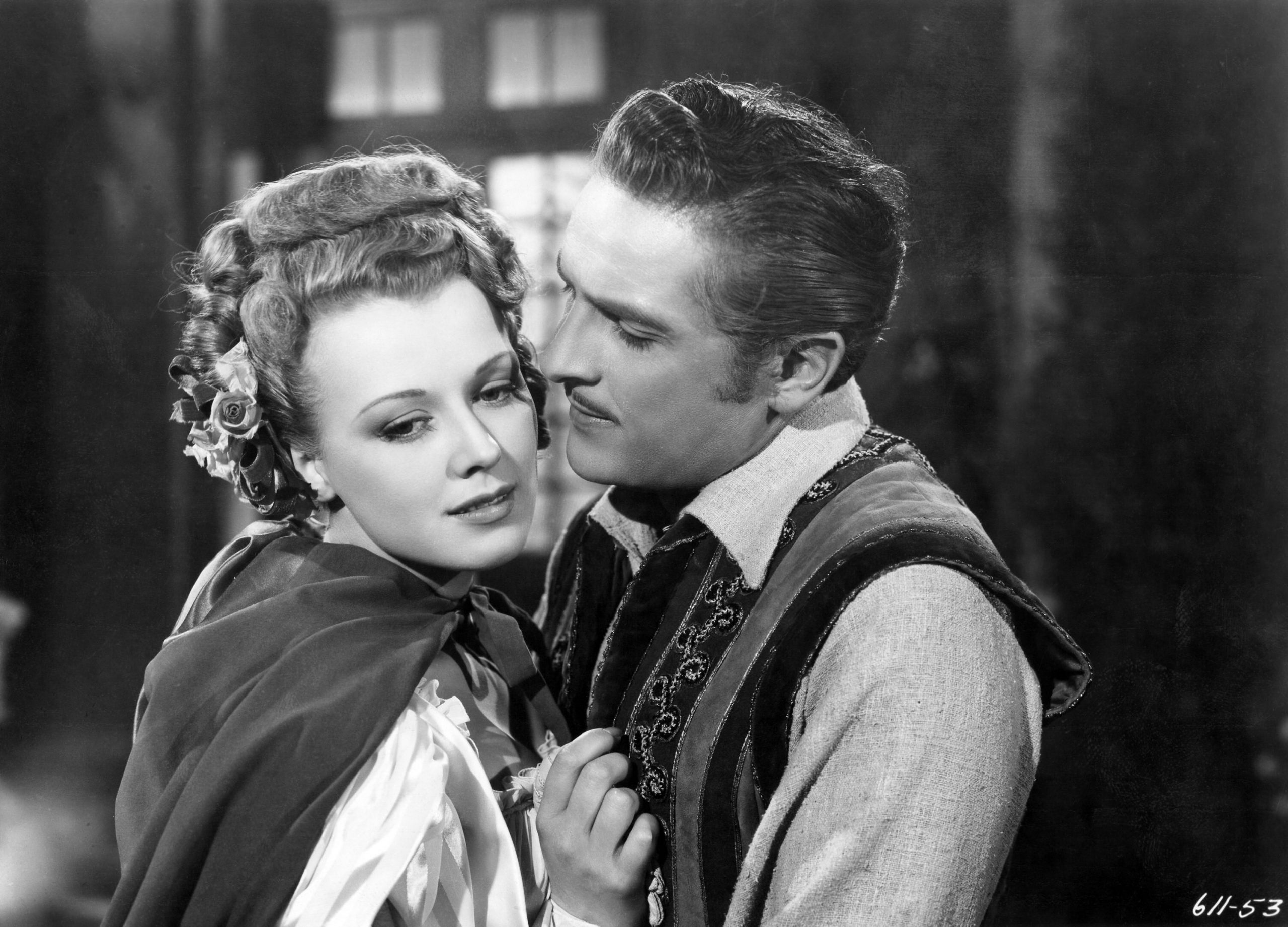
Who do you call when you want to liberate Sicily? Who else but Casanova? Spanish-English-language cross-market leading man Arturo de Córdova and Lucille Bremer of Meet Me in St. Louis (1944) star in this swashbuckling B-movie that has extraordinarily little to do with the real-life Giacomo Casanova. Summoned by a band of insurgents to lead a Sicilian rebellion against the Austrian Empire, Casanova seduces, swordfights and twists romantic complications into revolutionary intrigue. You can expect plenty of adventure, high romance, some light cross-dressing, production design that rivals major Hollywood studios, and George Tobias’ unmistakable thick Brooklyn accent.
From a historical perspective, Adventures of Casanova is more than the sum of its rather shlocky parts. The film represents a major step in collaboration between the Mexican and American film industries at the height of their respective power and prestige, a level of partnership possibly unmatched until the Nuevo Cine Mexicano movement of the 1990s and 2000s. Adventures of Casanova was also among the first films to make use of Mexico City’s Estudios Churubusco, one of the last legacy Mexican production studios still operating today. Although critics at the time cited budget outlay as the motivation behind the partnership, Adventures of Casanova does stand in contrast to the Mexploitation usually served up to the Anglo-American audiences of the period. Roberto Gavaldón, an icon of Mexican cinema, was perhaps the first Mexican director hired to lead an American crew outside the United States. Gavaldón would go on to make one more English-language feature, The Littlest Outlaw (1955), before returning fully to Mexican cinema. His film Macario, another work shot at Estudios Churubusco, would compete at Cannes in 1960 alongside La Dolce Vita and earn a nomination for Best Foreign Language Film at that year's Academy Awards.—Noah Brockman
DCP. Production: Bryan Foy Productions. Distribution: Eagle-Lion Films. Producers: Bryan Foy, Leonard S. Picker. Director: Roberto Gavaldón. Screenwriters: Crane Wilbur, Walter Bullock, Karen DeWolf. Cinematographer: Jack Greenhalgh. With: Arturo de Córdova, Lucille Bremer, Turhan Bey, John Sutton, George Tobias.
Restoration funding provided by the Hobson/Lucas Family Foundation. Restored by the UCLA Film & Television Archive and The Film Foundation from the 35mm nitrate original picture negative, nitrate fine grain, nitrate track negative and 16mm print. Laboratory services by Roundabout Entertainment, Inc., Audio Mechanics, Simon Daniel Sound, FotoKem. Special thanks to Harvard Film Archive, Cinedigm.