More Information
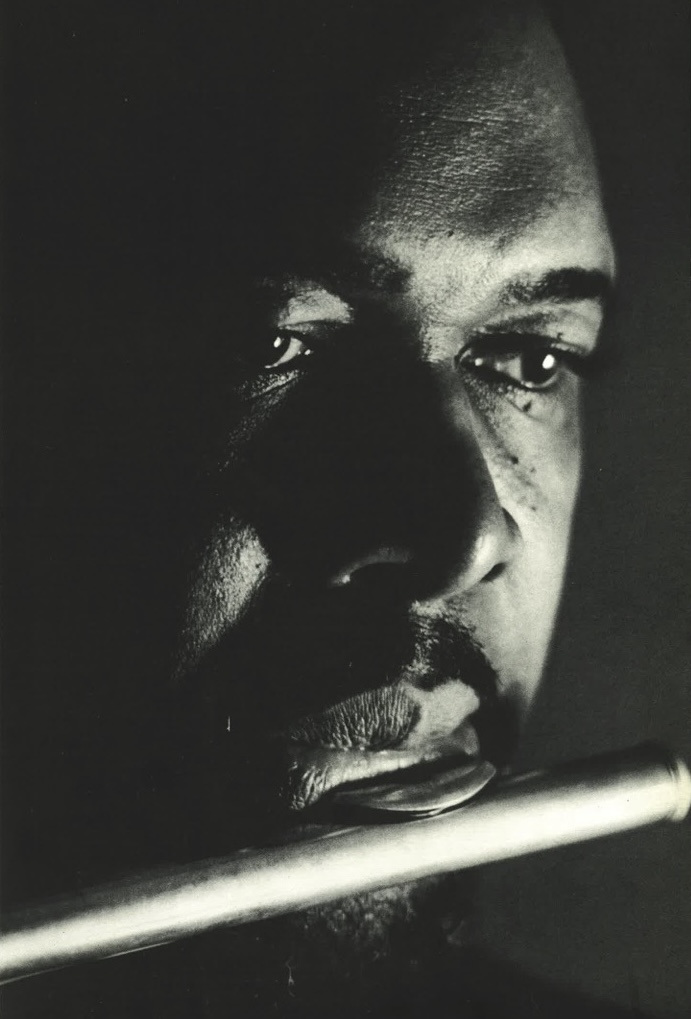
The Buddy Collette papers and American Federation of Musicians Local 767 records document a history of Los Angeles, in which music, union activity, and civil rights struggles were closely intertwined.
Through handwritten music, photographs, audiovisual materials, union files and personal objects, the collections trace Collette’s creative process and the broader world of Black musicians working, organizing and building community in the city. Viewed together, they preserve a central chapter in the cultural and social history of Los Angeles.
Buddy Collette Papers
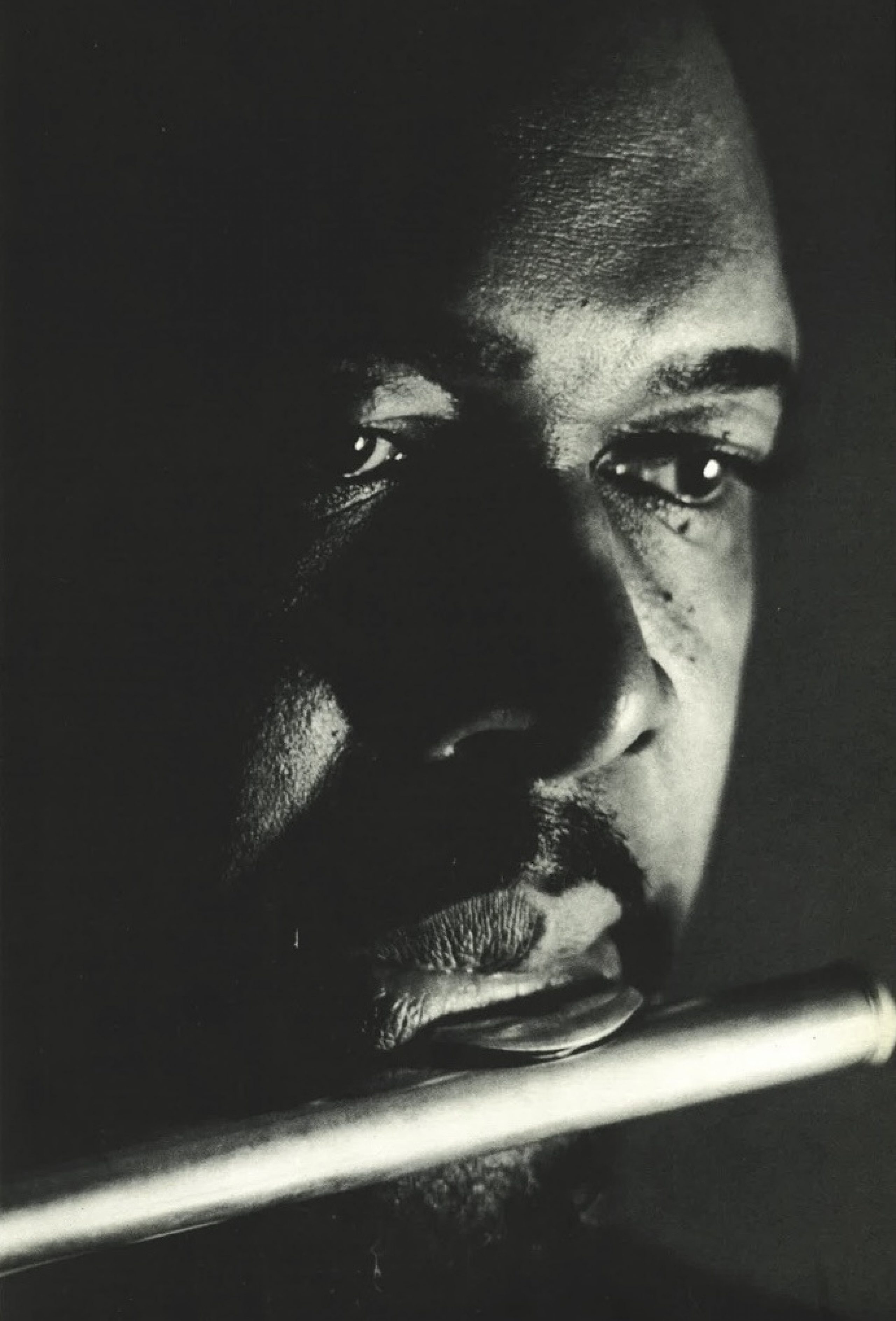
Buddy Collette (1921-2010) was a jazz multi-instrumentalist, composer and educator whose professional and personal career was centered largely in Los Angeles.
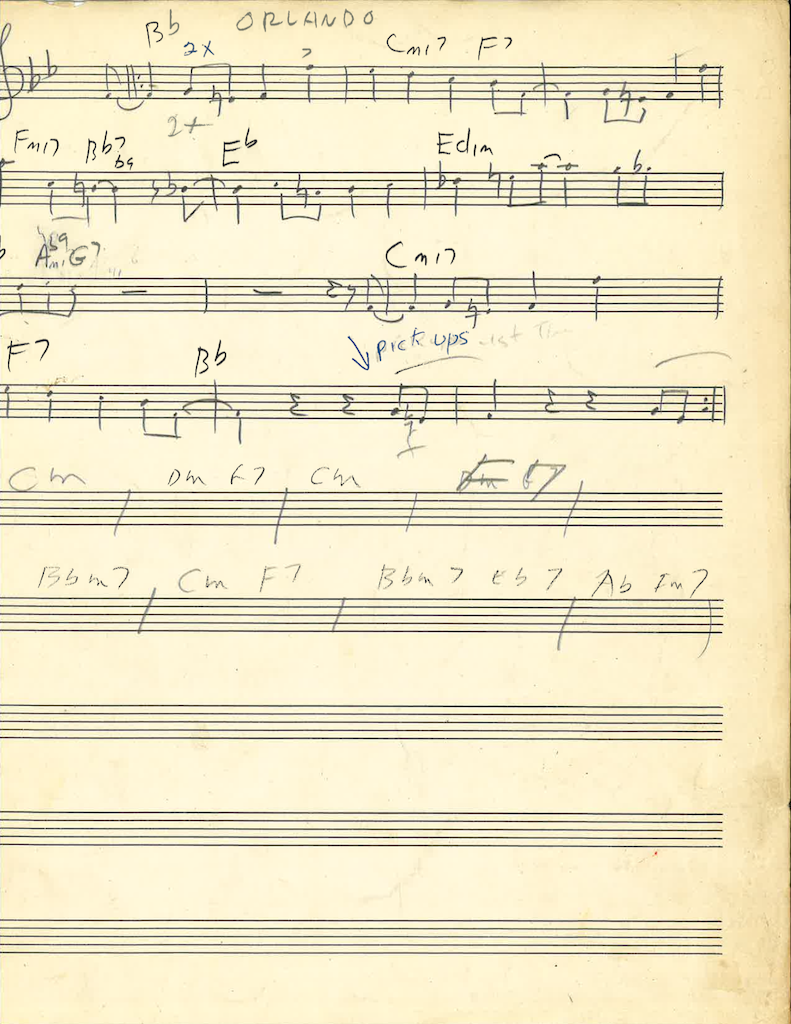
His papers(opens in a new tab) span roughly the 1940s through the early 2000s and include correspondence, musical manuscripts, photographs, writings, audiovisual and digital materials. The collection reflects the range of his work, while also intimately showcasing the process behind it. Alongside finished compositions and professional records are sketches, drafts and notes that show how Collette’s ideas developed over time
AFM Local 767 Records
The American Federation of Musicians Local 767 records(opens in a new tab) provide an institutional context for that creative life. Local 767 was the Los Angeles branch of the American Federation of Musicians for Black musicians during the era of segregated union locals.
Spanning 1920 to 1965, the collection includes meeting minutes, election materials, membership and financial records, correspondence, contracts and claim files. These materials document the day-to-day work of the union, while also preserving a major point in local history: the 1953 amalgamation of Local 767 with Local 47, which made Los Angeles the first city in the union where Black and white locals merged.
Working with the Collections
I first encountered these collections through the Center for Primary Research Training as a processing scholar.
What initially stood out to me was how immediate these collections felt. It was one thing to read about an individual and their history; it is another to hold Buddy Collette’s master tapes, organize his handwritten sheet music and move through the folders that document his creative life draft by draft.
The materials made Collette feel unexpectedly close, preserving
his revisions, experimentation and the ordinary habits through which
music is made.
Collette's Musical Process
Coming into this collection with a background in labor and general music history, I was excited and very interested in the material, but I didn’t expect to learn so much about the creative process and get the opportunity to enter into the mind of a musician.
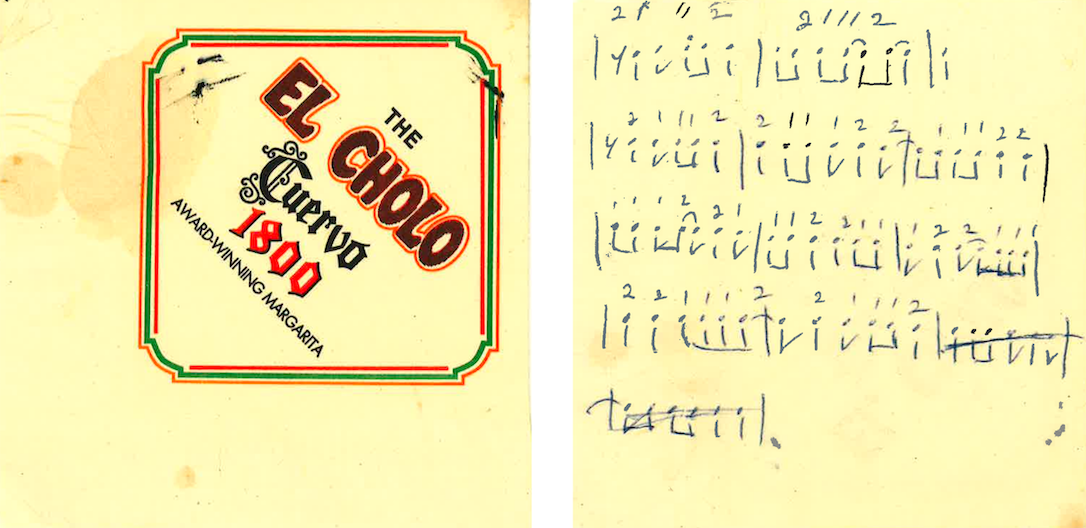
One of the most interesting objects that I encountered was a napkin from the Mexican restaurant El Cholo with handwritten music on it. Small and informal, it captures something that a polished manuscript cannot: that Collette’s compositional process was ongoing and mobile, that a musical idea could arrive anywhere, and that he was ready to write it down between bites of a meal.
The napkin is a reminder that materials don’t need to look official to be historically meaningful; sometimes the most revealing items are the ones that seem incidental at first glance.
A Deciding Moment
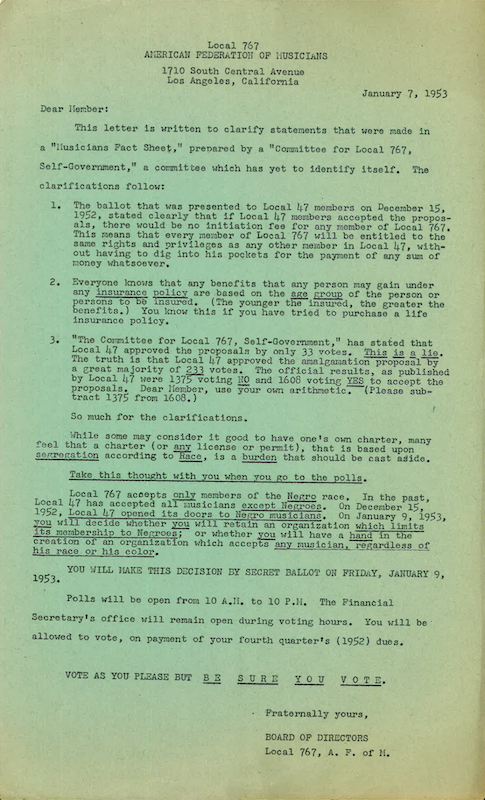
The AFM collection also contained one of the most memorable discoveries of the project: an election notice to members discussing the vote on whether the union would remain segregated or move toward integration.
The notice outlined three options for members: to decide whether to retain an organization limited by race, merge with the white Local 47, or create a union open to all musicians regardless of race or color. The outcome was to be determined by a secret ballot on January 9, 1953.
This document captures the uncertainty of the integration decision as it was unfolding and preserves the decision-making process behind the historical change.
Connecting the Collections
Other materials further connect the two collections, revealing Collette’s direct involvement in the union.
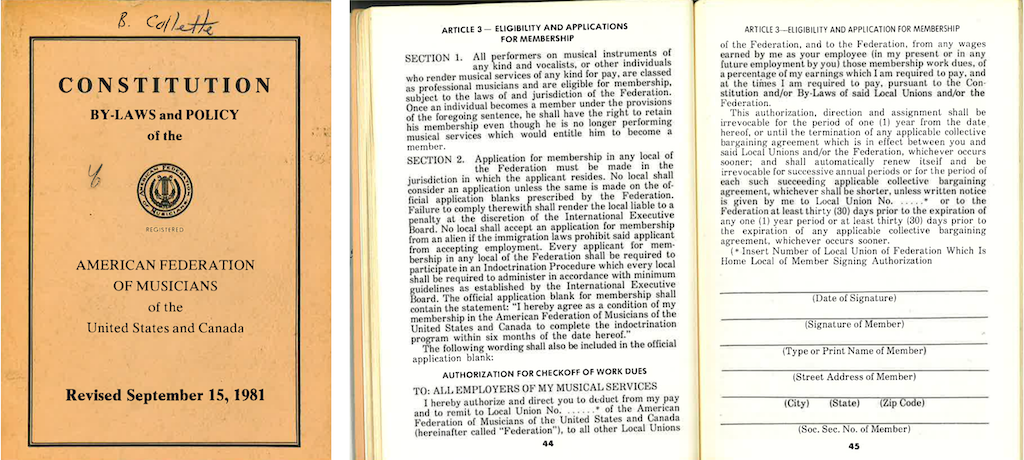
Union records show that he ran as the pro-amalgamation candidate for president of Local 767 in 1951, served on the committee formed to begin merger discussions with Local 47 and later served as a trustee. Read alongside Collette’s pocket constitution found in his personal papers, these materials suggest that the union was a central part of Collette’s professional world.
Processing the Collections
The collections were also complex in ways that shaped my work as a processor. Some materials were clearly identifiable and easy to place, while others were loose, handwritten, incomplete or difficult to date. Processing them required decisions about arrangement and description that would preserve the context while also making the collection more accessible for future users.
In the Collette papers, this meant paying attention to drafts and manuscript groupings that documented both finished work and creative development.
In the union records, it meant piecing together fragments of administrative files to reconstruct the story of how the union operated and the individuals involved.
Preservation and Care
One of the most valuable parts of the project was learning how archival access often depends on preservation needs.
I learned mold treatment techniques from the staff from the Preservation & Conservation Department, freezing affected original sheet music for a couple of weeks and then carefully using a soft brush to remove the mold. This process gave me a deeper appreciation of the physical care archival work requires.
I also learned how to assemble custom archival housing for a large leather financial ledger from Local 767. These experiences reinforced that preservation is just as essential as arrangement and description in ensuring the continued access of collections.
Reflection
As I worked through these materials, I came to understand archives as more than physical repositories. They are places where history becomes legible and where meaningful points of entry can be made available for users.
As an emerging archivist with a love for music and labor history, working with these collections has been an invaluable learning experience. I will carry forward the archival and preservation skills I developed, including description, finding aid creation, rehousing of mixed-format materials and physical organization, into my future professional archival roles.
What remains most with me is the way these collections make history feel both expansive and personal. They have deepened my appreciation for the many forms of care required to bring Buddy Collette’s materials and the AFM Local 767 records into clearer view.