Visit the UCLA Film & Television Archive website(opens in a new tab) to learn more about upcoming screenings and events.
Free admission. No advance reservations. Your seat will be assigned to you when you pick up your ticket at the box office. Seats are assigned on a first come, first served basis. The box office opens one hour before the event.
In person: Q&A with UCLA Asian American Studies Assistant Professors Loubna Qutami and Nour Joudah, moderated by UCLA Comparative Literature Ph.D. student Aciah Abdulsater.
Every space hosts the accumulation of time and is thus a repository of memory, one that is active and dynamic.
Jean Khalil Chamoun’s Women Beyond Borders (2004) and Theo Panagopoulos’ The Flowers Stand Silently, Witnessing (2024) were made two decades apart, but together they foster an ongoing conversation at the intersection of identity, memory and place across Lebanon and Palestine.
Though distinct in form, the films consider the relationship between people’s lived environments and their individual and collective identities. The films navigate through spaces both historically and presently marked by displacement, violence and resilience. Both offer meditations and testimonies on how these spaces can inhabit a people’s memories, linger into their present realities and influence their futures.
Rather than attempting to unearth a singular tradition, this program amplifies an ongoing cinematic conversation across Lebanon and Palestine that is rooted in intertwined histories of occupation and resistance. This conversation is an urgent one to hold today in light of the ongoing aggression against southern Lebanon and historic Palestine that continues to target complete ecosystems. This systematic surge of destruction and harm affects far beyond the physical; it seeks to fracture memory, sever a people’s sense of being and belonging, and jeopardize social relations that places sustain. The moving image as a tool presents an opportunity to forge an alternative place of memory work, one capable of preserving spatial memory, making visible the forms of erasure, and imagining continuities that exceed the violence of occupation and its imposed restriction on bodies and space.
Programmed by UCLA Comparative Literature Ph.D. student Aciah Abdulsater and Archive Research and Public Access Coordinator Nicole Ucedo. Notes and concept by Aciah Abdulsater.
Screening 1 of 2
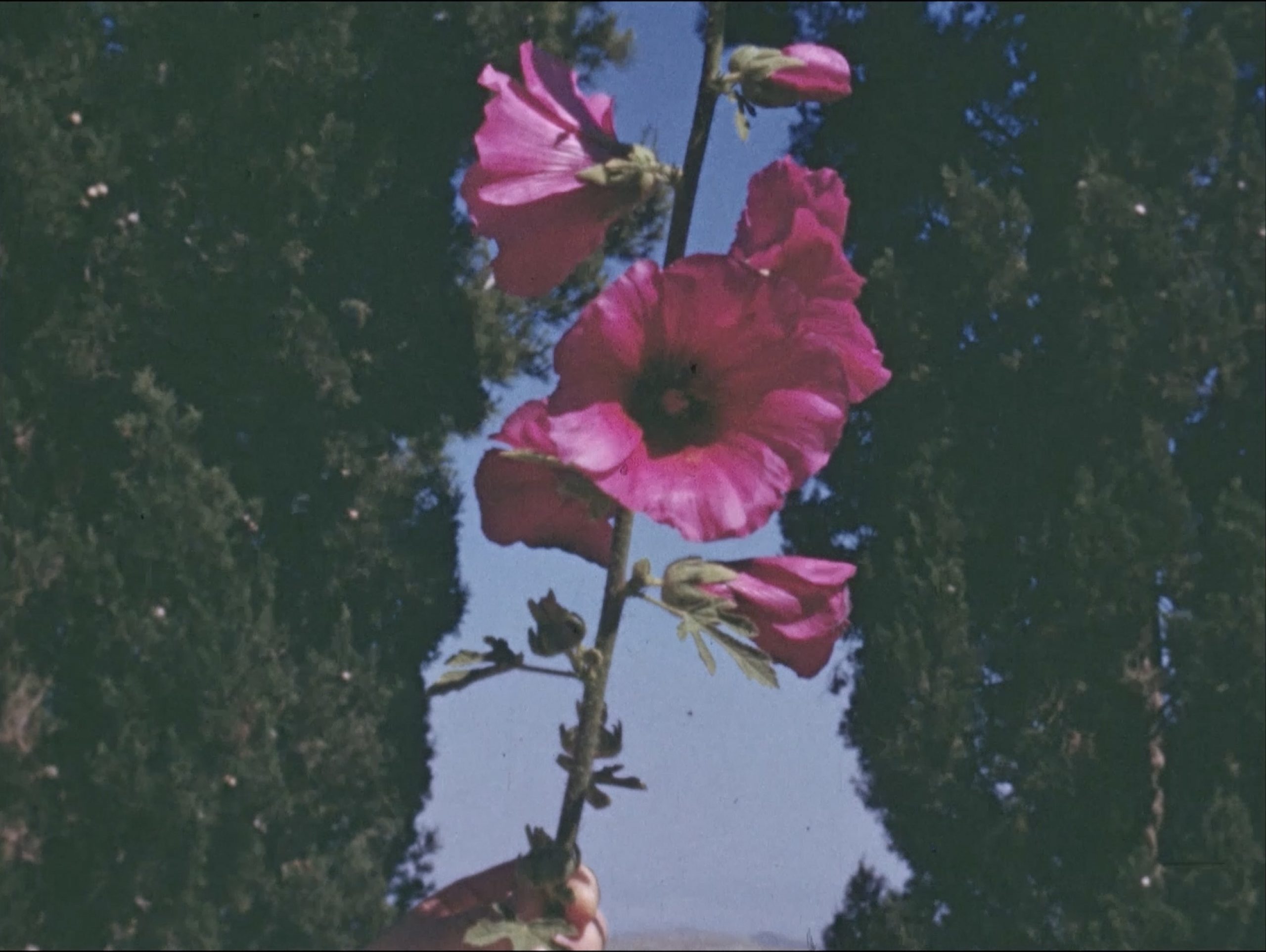
The Flowers Stand Silently, Witnessing
Year: 2024 Country: U.K. / Palestine / Lebanon / Greece Language: no spoken dialog with English and Arabic captions Runtime: 17 min. Digital. Color
Filmmaker and researcher Theo Panagopoulos’ essay-style documentary assembles recently rediscovered archival footage of Palestinian wild flowers, filmed in the 1930s and ’40s by a Scottish missionary during the British Mandate. Panagopoulos decides to reclaim the footage. In reframing the images with new sound and captions he questions the role of image-making as both a tool of witnessing and a perpetrator of violence, when covering the relationships between people and land.
Director/Screenwriter: Theo Panagopoulos.
Screening 2 of 2
Women Beyond Borders
Year: 2004 Country: Egypt / Palestine Language: Arabic with English subtitles Runtime: 58 min. Digital. Color
In a feature-length documentary, filmmaker Jean Khalil Chamoun follows the story of Kifah Afifi, a Palestinian refugee, Sabra and Shatila massacre survivor, and ex-abductee at the infamous Khiam detention center in then-occupied southern Lebanon. The film explores questions of womanhood and women’s relationship to community and space. By following Kifah’s recollection of her time in detainment, her struggles and what anchored her hope, the film sheds light onto women who defied societal, historical and political boundaries.
Director/Screenwriter: Jean Khalil Chamoun.